Birdeye vs NiceJob.
Compare pricing, scope, and the tools your team will use. We also include our own $29 monthly review tool, ReviewNudger, so you can weigh a simpler option.
14-day free trial · card required · then $29/mo per location · cancel anytime
Trial: up to 50 SMS attempts from your approved toll-free number or, when the sending conditions are met and one is available, a ReviewNudger number during carrier review. See pricing for sending limits.
Birdeye vs NiceJob at a glance
Start with pricing, trial terms, support, and the day-to-day workflow. ReviewNudger is included as our $29-per-location option.
Swipe across the table to see every platform.
| Compare | One plan. All core features. | Birdeye | NiceJob |
|---|---|---|---|
| Price | $29 per month per location, published, flat — no customer tiers | Custom quote; no public entry price | Published: $75 per month Starter plan, $125 Pro |
| Free trial | 14 days free · $0 today · card required | Ask sales about trial availability | 14-day free trial |
| Customer support | Email support with a real human | Confirm support options in your quote | Confirm support for your selected plan |
| Core product | Google review requests triggered by completed payments | Experience management: reviews, listings, surveys, reporting | Reputation marketing: reviews, referrals, social-proof widgets |
| How you buy | Self-serve with a 14-day trial, month-to-month | Custom quote through sales; confirm the term | Self-serve with a 14-day trial, no contracts |
| Best-fit business | Service businesses that want the review ask tied to the payment | Multi-location brands with marketing staff and listings needs | Small service businesses that also want referrals and social proof |
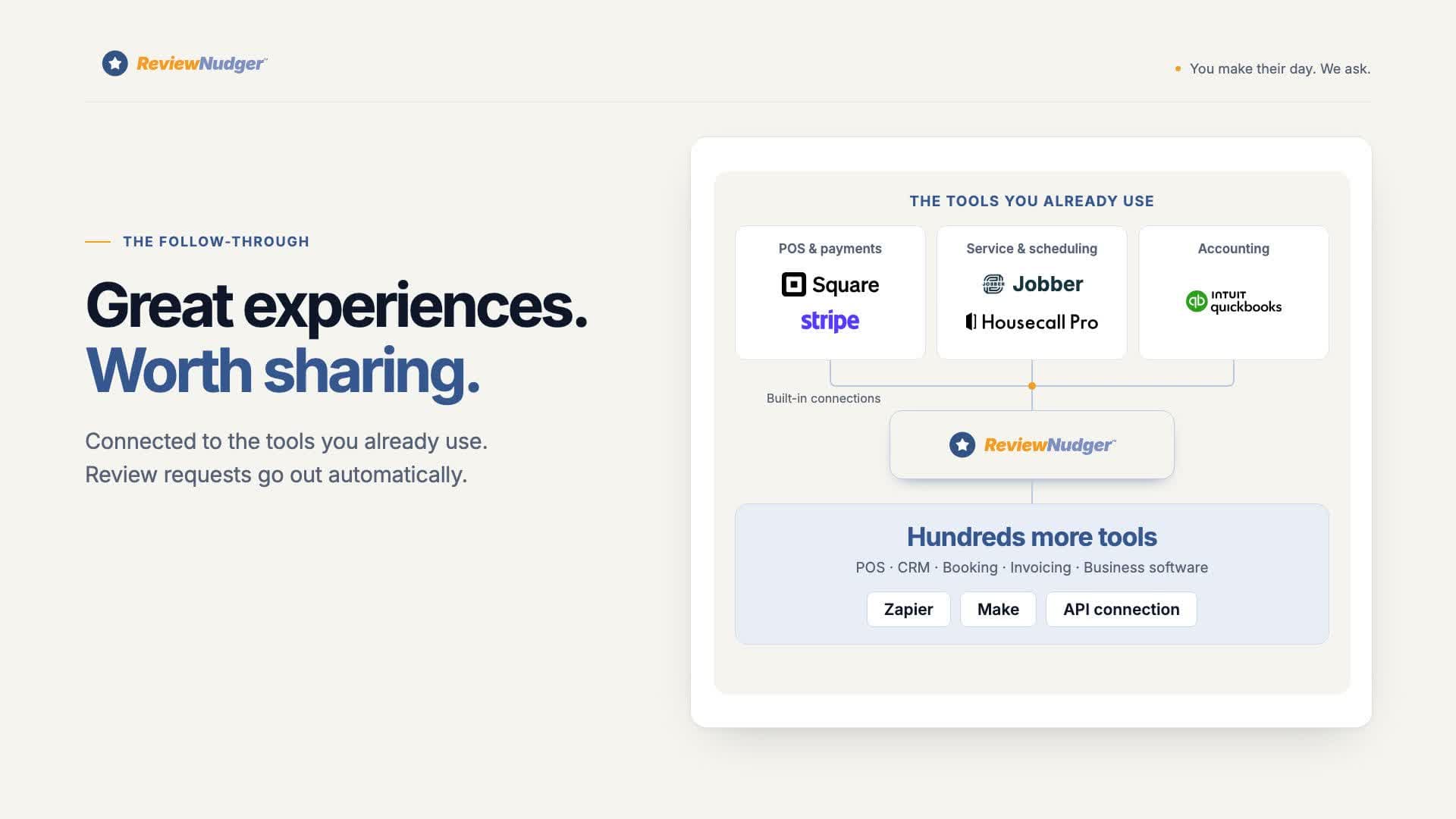
| Review request trigger | Automatic after completed payments in Jobber, Square, QuickBooks, Stripe, or Housecall Pro | Campaigns and automations configured in the platform | Campaigns enrolled from connected apps and contact lists |
What each platform is
Birdeye and NiceJob both sell reputation software, to very different buyers. Birdeye is enterprise-shaped: listings management across dozens of directories, surveys, social publishing, and reporting for multi-location brands, sold through custom quotes. NiceJob is small-business-shaped: self-serve review requests, referrals, and social-proof widgets with published pricing from $75 per month. Most businesses comparing the two only need one of those shapes — and some need neither, which is why this page also names the $29 option for the narrower job of turning paying customers into Google reviews.
Birdeye
Birdeye is an experience-management platform for multi-location businesses and brands: review generation and monitoring, business-listings management across dozens of directories, surveys, social publishing, and brand-level reporting. Birdeye requires a custom quote; its public pricing page does not publish an entry price. Ask for the location count, included products, fees, and term in writing.
NiceJob
NiceJob is reputation-marketing software for small service businesses: automated review requests with follow-up reminders, review monitoring, with AI replies on Pro, social-proof widgets, referral campaigns, and an optional website product. Pricing is published — $75 per month for the Starter plan, $125 for Pro — with a 14-day free trial and no contracts.
Ask. Follow up. Reply. All in one place.
The features that turn a finished job into a consistent review routine, included in your $29 monthly plan.
SMS & email requests
The job is done. The review ask is ready.
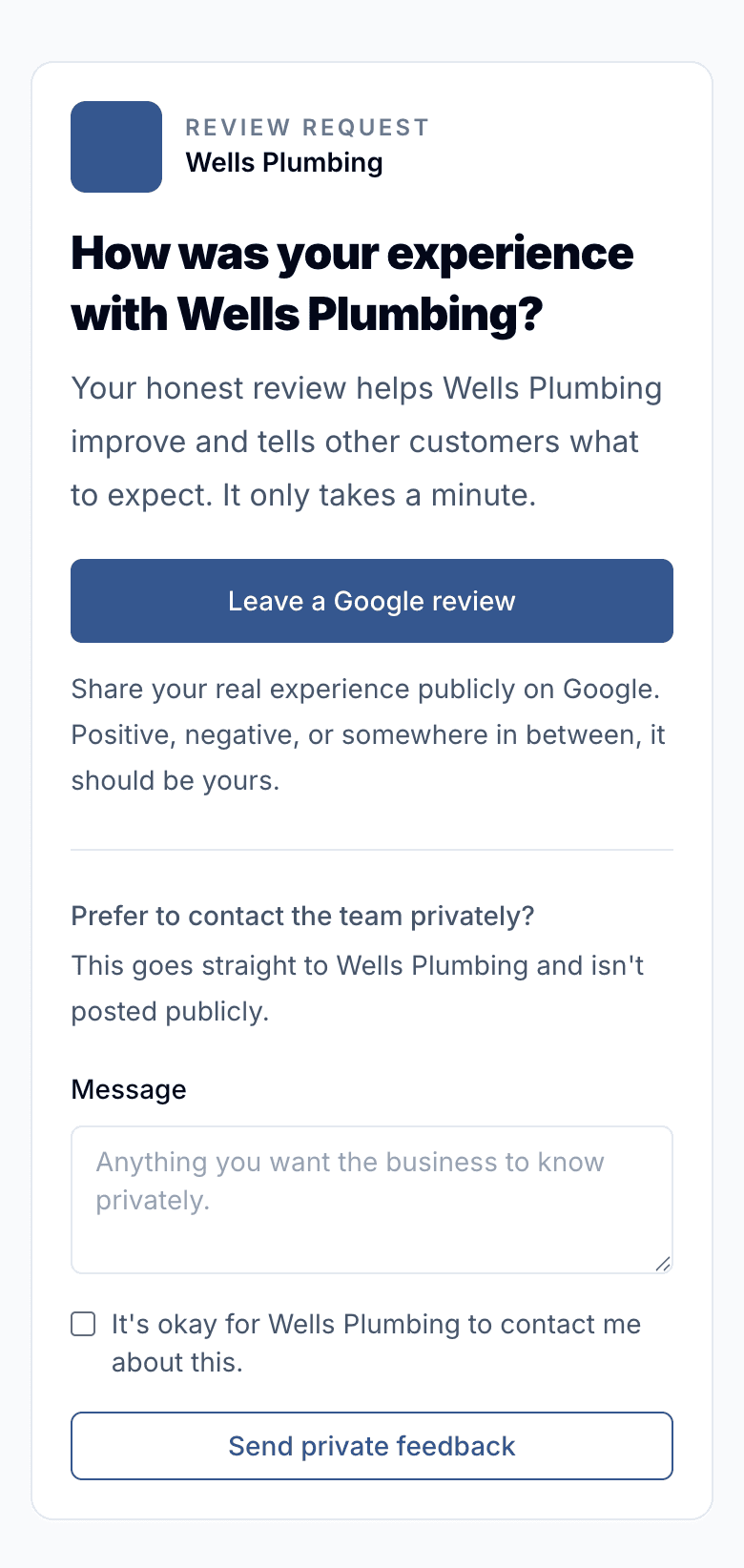
Connect a supported payment or appointment app and let completed work start the request. Customers get a branded page with a clear path to Google and any other public review links you add.
- Personalized text and email requests
- Send automatically, manually, or from a CSV import
- A public review link for every customer
Follow-up campaigns
Give busy customers a timely reminder.
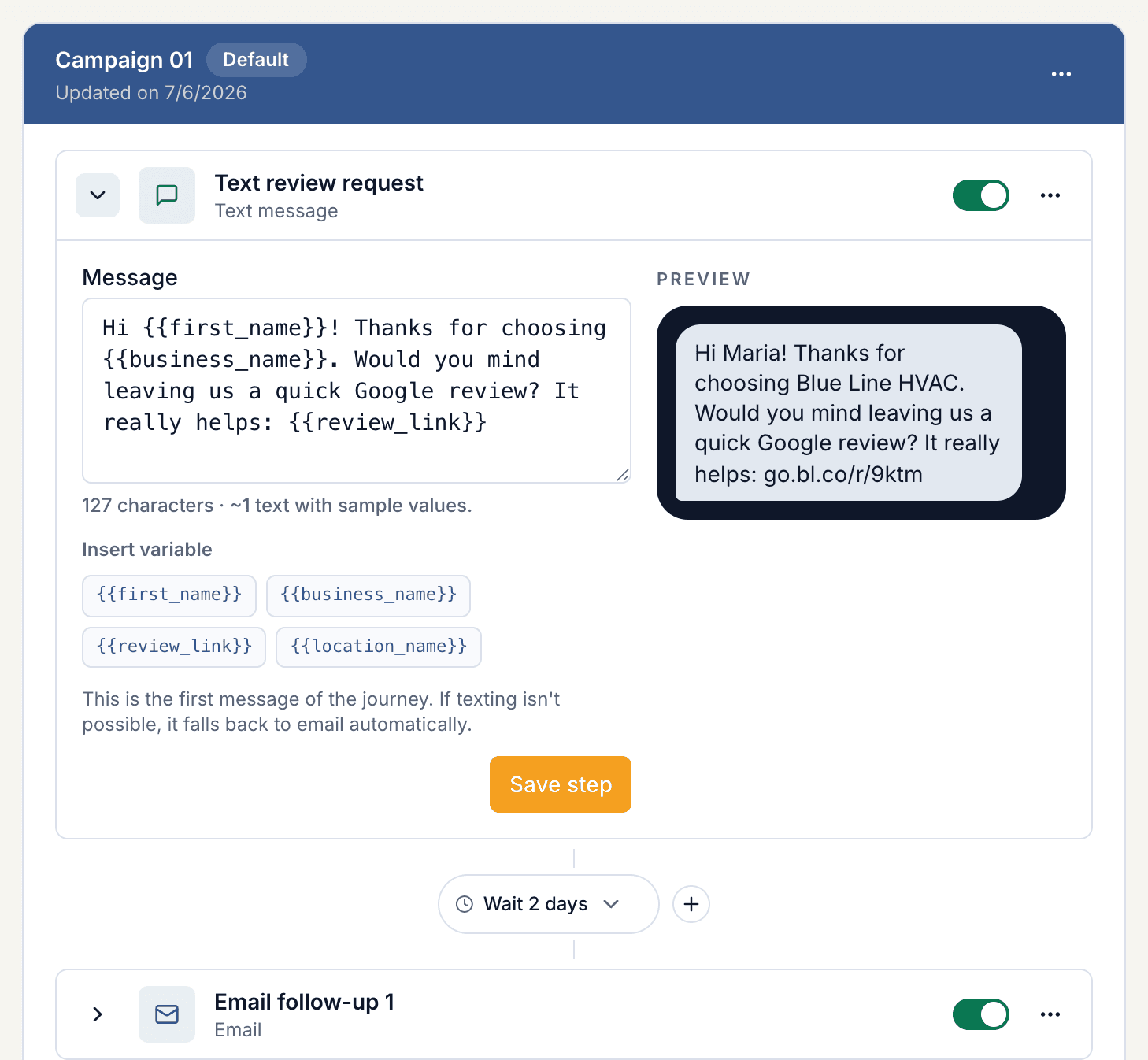
Build an ordered sequence of texts and emails. Choose the wait between steps, write the message in your own voice, and pause follow-ups when you need to.
- Combine SMS and email in the same campaign
- Control the timing and copy of each step
- Built-in opt-outs, cooldowns, and duplicate protection
Google reviews & AI replies
A thoughtful reply, without the blank page.
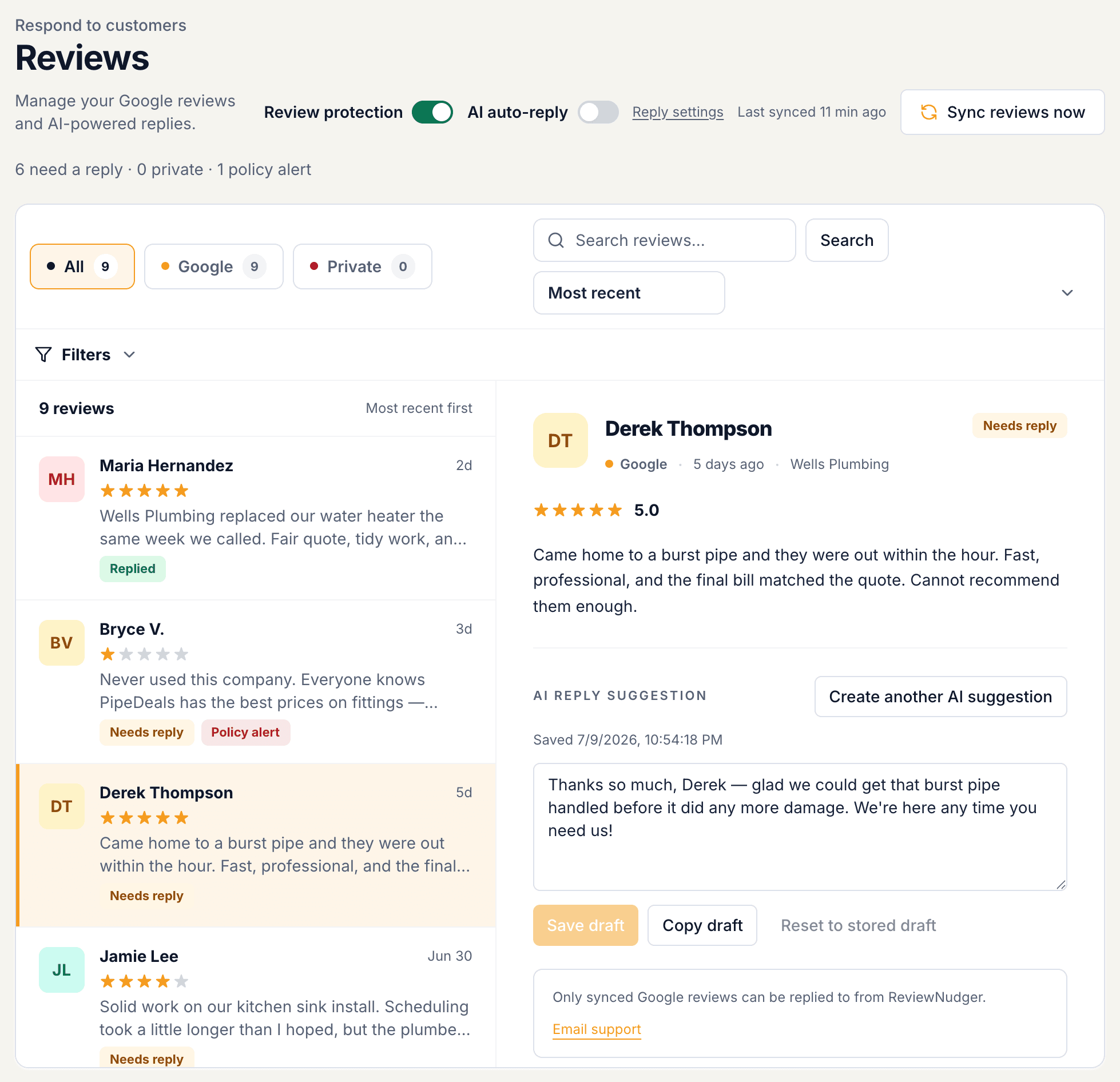
Read your synced Google reviews in one inbox. Start with an AI draft you can edit, or enable automatic replies with your chosen settings. New negative-review alerts help your team know when to step in.
- Editable AI drafts and optional automatic replies
- Search and filter your Google reviews
- Unlimited team members to share the follow-through
Review activity & feedback
See what happens after the ask.
Follow request activity, review growth, and customer feedback from your dashboard. See what needs a reply and which requests need attention, then keep your team focused on the next useful action.
- Review counts and rating trends in one dashboard
- Customer feedback alongside review-request activity
- Advisory review protection helps you assess policy violations
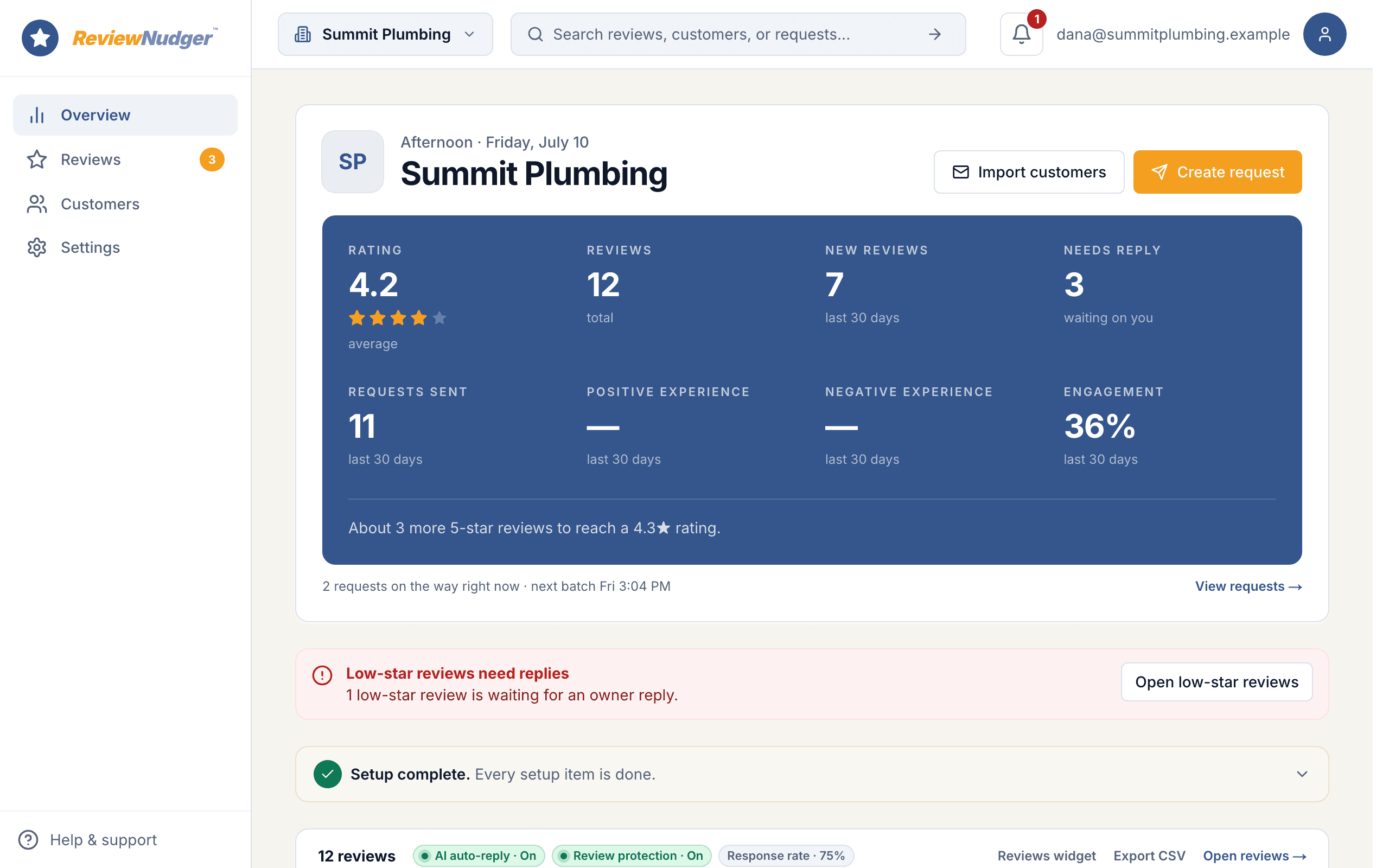
Product screens show example activity. Trial: up to 50 SMS attempts from your approved toll-free number or, when the sending conditions are met and one is available, a ReviewNudger number during carrier review. See pricing for sending limits.
See the request your customers receive.
Try the customer experience before you choose your review software.
Which should you pick?
When Birdeye is the right call
Pick Birdeye if you operate at multi-location scale: listings that must stay consistent across dozens of directories, surveys, and brand-level reporting a marketing team will actually use. That machinery is Birdeye's real product, and neither NiceJob nor a focused review tool replaces it.
When NiceJob is the right call
Pick NiceJob if you are a small service business that wants reputation marketing breadth — review requests plus referral campaigns, social-proof widgets, and an optional website — self-serve, with published pricing and no contracts. It is genuinely built for the small-business buyer.
The $29 third option: ReviewNudger
If the goal is narrower still — every paying customer asked for a Google review automatically, right after payment — ReviewNudger does that one job for a published $29 per month per location: payment-triggered requests, Google review sync, AI reply drafts, and review protection, flat pricing with no customer tiers. We make ReviewNudger, so weigh this paragraph accordingly; the table above stands on its own.
One plan. The whole review workflow.
Start with a 14-day trial. Keep the tools your team needs for $29 per month per location.
ReviewNudger
$29/ month
Per location · cancel anytime
Start free trial$0 today · card required · no charge until your trial ends. Trial: up to 50 SMS attempts from your approved toll-free number or, when the sending conditions are met and one is available, a ReviewNudger number during carrier review. See pricing for sending limits.
A toll-free texting number is included. A local area-code number is an optional $100/year add-on.
Full pricing and trial details- Automatic text or email review requests
- Connects to your Google Business Profile to pull in every review
- AI-suggested replies you can edit, plus optional auto-reply
- Full review inbox with search and filters
- Automatic asks after payments in Jobber, Square, QuickBooks, Stripe, and Housecall Pro
- Automatic follow-up messages you control
- Review protection that flags spam and fake-looking reviews
- Alerts when negative reviews come in
- A review widget and "Review us" buttons for your website
- A private link and QR code so staff can ask on the spot
- Optional thank-you email after a customer reviews you
- Unlimited team members, one location
- Your own toll-free texting number, with carrier approval handled for you
- Email support with a real human
Where we stand on review gating
A note on review gating, because it matters when you compare tools: by default ReviewNudger sends every customer the same neutral request with the same public Google review link — no sentiment checks and no star-rating questions deciding who gets asked. There is one optional, clearly disclosed per-location mode that asks how the visit went first, and even in that mode the public Google review link stays available to every customer, including unhappy ones. Selectively suppressing negative reviews violates FTC rules and Google's review policies, so whichever platform you choose, make sure its defaults keep you on the right side of both.
Where we stand on review removal
A note on review removal, because it comes up in the same comparisons: ReviewNudger includes review protection, which can screen newly synced Google reviews for likely violations of Google's review content policy — spam or fake content, off-topic content, conflicts of interest, profanity, harassment, hate speech, exposed personal information — and flag what it finds with a plain-English explanation. It is advisory only and configurable per location: you decide which flags deserve action and report them through Google's own reporting tool. ReviewNudger never submits reports on your behalf, and whether a flagged review comes down is always Google's decision — so whichever platform you choose, treat guaranteed-removal promises with skepticism.
Competitor pricing reference: September 28, 2026. Prices and quote requirements come from the linked official vendor pages. Confirm current pricing, included features, and terms with the vendor before buying.
Related comparisons and resources
Read the direct alternative pages, check the buying criteria, or review the plan before starting a trial.
Frequently asked questions
Is Birdeye overkill for a single-location business?
Often, yes. Birdeye's packaging assumes listings, surveys, and reporting needs that come with scale, with pricing provided by custom quote. A single-location business that mainly wants review volume usually gets there with a far smaller tool — NiceJob at a published $75, or a payment-triggered request tool at $29.
Is NiceJob big enough for multiple locations?
NiceJob serves small service businesses and also offers franchise options. Confirm the location scope and price for your organization. A brand with many locations that needs per-location listings management and consolidated reporting will outgrow that shape — which is the scenario Birdeye is actually built for.
Which gets more Google reviews?
Volume comes from mechanics, not brand: ask every customer, quickly after the work, by text, with a one-tap link, plus one follow-up. Any of these tools can run that play; what differs is what triggers the ask, how much platform you buy around it, and what it costs per month.
Do these tools avoid review gating?
Review gating — screening out likely-unhappy customers before showing the review link — violates the FTC's consumer-review rules and Google's policies regardless of which software you use. Evaluate every tool's defaults, and keep the public review link available to every customer.
Questions before you start? Email support@reviewnudger.com and a human will answer.